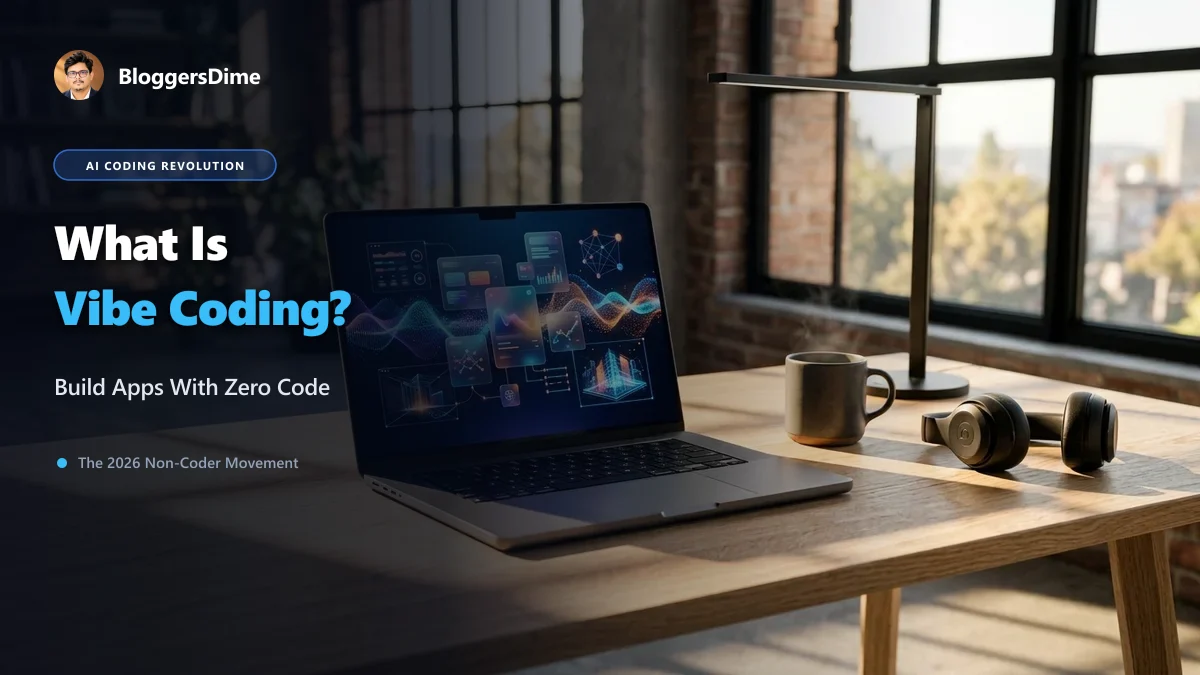
What Is Vibe Coding? How Non-Programmers Are Building Real Apps Using AI (2026 Guide)

For the past four decades, building software required one mandatory prerequisite: you had to spend hundreds of hours memorizing esoteric programming syntax, wrestling with semicolons, debugging obscure terminal stack traces, and understanding complex data structures. If you had a brilliant app idea but didn’t know JavaScript, Python, or SQL, your vision remained trapped in a notebook.
In 2026, that barrier has dissolved overnight. A viral cultural and technical phenomenon known as “Vibe Coding” is turning designers, marketers, accountants, teachers, and total non-programmers into prolific software builders. People who have never touched a terminal are shipping production-ready web apps, internal company tools, and lucrative micro-SaaS businesses in a single weekend.
If you have recently explored how Perplexity AI is transforming research or how to automate your workflow with 7 free AI tools that save 10+ hours a week, vibe coding represents the next monumental leap. Here is your definitive guide to what vibe coding is, how it works, and how you can build and launch your first real application without writing a single line of traditional code.
The Origin: How Andrej Karpathy Coined “Vibe Coding”
The term was popularized in early 2025 by Andrej Karpathy, a legendary AI researcher, founding member of OpenAI, and former Director of AI at Tesla. Karpathy posted a thought-provoking observation on X (formerly Twitter) describing his personal evolution as a computer scientist:
“There is a new kind of coding I call ‘vibe coding’, where you fully give in to the vibes, embrace impatience, and forget that the code even exists. I just see stuff, say stuff, run stuff, copy-paste stuff, and it mostly works.”
Karpathy confessed that while creating working software prototypes, he was no longer typing keyboard characters, inspecting functions line-by-line, or reading documentation. Instead, he was simply communicating his intent in plain English to an AI model, accepting changes, and steering the product based on “vibes”—how the interface felt and whether it behaved as intended.
What started as a playful tweet quickly exploded into a global movement. Silicon Valley founders, venture capitalists, and everyday creators realized that English had officially become the most powerful programming language on Earth.
What Exactly Is Vibe Coding? (Beyond the Buzzword)
At its core, vibe coding is the practice of software creation where the human acts as the Product Architect & Creative Director, while an autonomous AI agent acts as the Lead Software Engineer.
Instead of thinking in variables, loops, arrays, and CSS media queries, a vibe coder thinks in outcomes, user flows, and product design:
- “Build me a clean, minimalist dark-mode dashboard where freelance writers can track invoices, calculate late fees, and export PDF summaries.”
- “When a user clicks this button, trigger a confetti animation and send a confirmation email via Resend.”
- “The mobile navigation menu is overlapping with the hero logo on iPhone screens. Fix the spacing and make the menu close smoothly when tapped.”
The AI translates these human instructions into hundreds of lines of pristine React, Next.js, Tailwind CSS, and database queries in seconds, while the human tests the live browser preview and provides iterative feedback.
Traditional Coding vs. No-Code vs. Vibe Coding
To understand why vibe coding is winning, it helps to see how it compares to previous attempts at democratizing software development:
| Feature | Traditional Coding | No-Code Builders (Bubble, Webflow) | Vibe Coding (AI Agents) |
|---|---|---|---|
| Learning Curve | Steep (6 to 24 months of dedicated study) | Moderate (steep learning curve for complex workflows) | Very Low (Conversational English) |
| Speed to Prototype | Weeks to months | Days to weeks | Minutes to hours |
| Code Ownership | 100% full ownership of source files | Locked inside proprietary vendor platform | 100% standard open code (Git, Next.js) |
| Customization Limits | Virtually limitless | Restricted by platform plugins & templates | Virtually limitless (AI writes custom logic) |
| Hosting & Export Costs | Low (inexpensive standard cloud hosting) | High monthly vendor subscription lock-in | Free to low-cost (deployable to Vercel, Cloudflare, Netlify) |
The 2026 Vibe Coding Stack: Essential Tools
You don’t need a fancy computer science degree or hundreds of dollars in enterprise software to start vibe coding today. Here are the leading platforms empowering non-technical creators:
1. Cursor AI (The King of AI Code Editors)
Cursor is a fork of Microsoft’s VS Code supercharged with deep AI integration. It understands your entire codebase, scans for errors in real-time, and allows you to press Cmd+K (or Ctrl+K) to prompt changes directly into any file. Its “Composer” feature acts as a full-fledged autonomous developer that creates multiple files, installs packages, and fixes its own mistakes.
2. Lovable.dev & v0 by Vercel (Prompt-to-Full-App in Your Browser)
If you don’t even want to install an editor on your desktop, browser-based tools like Lovable and v0.dev are pure magic. You type a prompt describing what you want, and within 45 seconds, a fully interactive React application renders before your eyes. You can click on any element, tell the AI to tweak colors or add functionality, and connect a Supabase database with one click.
3. Claude 3.7 Sonnet & OpenAI o3-mini (The Reasoning Brains)
Under the hood, vibe coding relies on advanced LLMs capable of long-context reasoning. Models like Anthropic’s Claude 3.7 and OpenAI’s reasoning models can comprehend thousands of lines of interconnected code, remember the architecture of your entire app, and identify elusive logical bugs before you even spot them.
4. Replit Agent (One-Click Autonomous Deployments)
Replit Agent takes vibe coding a step further: you give it a prompt, and it provisions a virtual environment, writes the frontend and backend, sets up database tables, tests the code, and gives you a public URL that anyone in the world can open on their phone.
The 4-Step Vibe Coding Playbook for Total Beginners
Want to build and launch your first functional web tool this weekend? Here is the exact blueprint used by top creators:
Step 1: Write a Crisp Product Specification (Spec)
Do not start by vaguely telling the AI to “build an app like Airbnb.” Instead, open a note-taking tool (or use Google NotebookLM to organize your thoughts) and write a 1-page spec detailing:
- Who the app is for.
- The 3 core screens (e.g., Landing Page, User Input Form, Results Dashboard).
- The specific data inputs and expected outputs.
Step 2: Start with the Visual Foundation (The UI)
Feed your spec into v0.dev or Lovable. Instruct the AI: “Build only the visual layout first with dummy placeholder data. Use Tailwind CSS, clean typography, modern cards, and generous white space.” Iterate until the interface looks polished and feels intuitive.
Step 3: Connect Live Functionality and Storage
Once you are happy with the visual design, prompt the AI to replace dummy data with real logic: “Connect this form to local browser storage so user inputs are remembered on refresh,” or “Generate a free Supabase database schema to store submissions.”
Step 4: Deploy to the World for Free
Push your project to GitHub and connect it to Vercel or Cloudflare Pages. In under 60 seconds, your project is live with free SSL, a global CDN, and lightning-fast loading speeds across the globe.
The 5 Golden Rules to Avoid “Spaghetti Code”
While vibe coding feels effortless, beginners often get stuck in frustrating loops where the AI breaks one feature while trying to fix another. To stay productive, follow these battle-tested rules:
- One Feature at a Time: Never ask the AI to add dark mode, payment processing, user authentication, and PDF exports all in a single prompt. Build, test, and save one feature before moving to the next.
- Leverage Git Version Control: Treat Git like a video game save point. Whenever a feature works, commit it (e.g.,
git commit -m "Working calculator logic"). If the AI hallucinates later, you can revert with zero stress. - Paste Exact Error Messages: If something breaks in your browser, don’t say “it is not working.” Open Developer Tools (F12), copy the red console error message verbatim, and paste it to the AI. AI fixes 95% of errors on the first try when given exact error logs.
- Keep Files Small and Modular: Instruct your AI editor to break complex code into smaller components (e.g.,
Header.tsx,Sidebar.tsx,InvoiceCard.tsx). Large monolithic files confuse LLMs and increase token costs. - Pair Vibe Coding with Focused Deep Work: Great software requires clear mental focus. Implementing a disciplined routine like the 90-Minute Deep Work Protocol allows you to design, build, and deploy high-quality software with zero distractions.
The Elephant in the Room: Will Engineers Be Replaced?
A common fear in tech circles is whether vibe coding spells the end of professional software engineering. The short answer is no, but the role is undergoing a historic evolution.
Vibe coding easily handles CRUD apps, landing pages, marketing calculators, internal admin tools, and interactive prototypes. However, mission-critical banking algorithms, low-latency financial exchanges, deep cybersecurity hardening, operating system kernels, and massive distributed databases still require rigorous human engineering judgment.
What is happening is a 10x leverage explosion: a single senior developer who masters vibe coding can now produce the output of a 10-person engineering team. Meanwhile, entrepreneurs, designers, and domain experts no longer have to wait months for an engineering department to approve their ideas—they can prototype, validate, and launch on their own.
Frequently Asked Questions (FAQ)
What does ‘vibe coding’ mean?
Vibe coding is a software development approach where the creator dictates application requirements, design ideas, and logic using natural English prompts to an AI coding assistant (such as Cursor, Claude, or v0), letting the AI generate, debug, and maintain all the code.
Who invented the term ‘vibe coding’?
The phrase was coined in early 2025 by Andrej Karpathy, a founding member of OpenAI and former Director of AI at Tesla, when he described building projects by talking to AI without actively reading or typing syntax.
Can beginners build real, working apps with vibe coding?
Yes. Complete beginners, marketers, product managers, and designers are building functional web apps, custom calculators, internal dashboards, and micro-SaaS products by combining AI code editors with modern cloud platforms like Supabase and Vercel.
What are the best tools for vibe coding in 2026?
The most popular tools include Cursor AI, Claude 3.7 / Sonnet, Lovable.dev, v0 by Vercel, Windsurf, and Replit Agent.
Will vibe coding replace professional software engineers?
No. While vibe coding lowers the barrier to entry for prototypes and simple applications, large-scale enterprise systems, cybersecurity, database architecture, and mission-critical performance still require deep engineering judgment.
Final Thoughts: The Democratization of Creation
For decades, the biggest bottleneck in human innovation was not a lack of good ideas—it was the technical friction required to bring those ideas into existence. Vibe coding removes that friction entirely.
Whether you want to build a customized budgeting tool for your family, an automated lead generation dashboard for your business, or a viral micro-SaaS product, the tools are now free, accessible, and waiting. You no longer need to learn to code. You just need to learn how to communicate your vision clearly and embrace the vibes.
Leave a Comment
Your email address will not be published. Required fields are marked *