Will AI Agents Replace Software Jobs? The Real Impact on Developers, Junior Coders & the Future of Programming

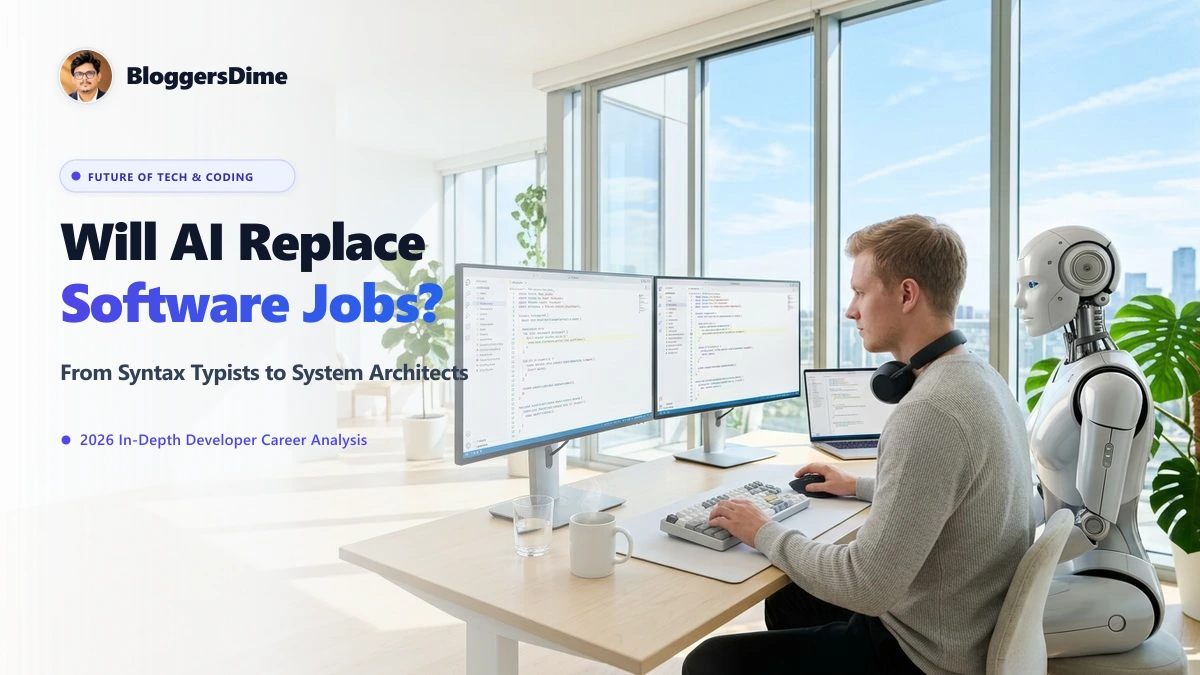
With the meteoric rise of autonomous coding agents like Devin, Claude Computer Use, GitHub Copilot Workspace, and OpenAI Canvas, a lingering panic has gripped the global technology industry: Will AI agents replace software jobs? Viral headlines proclaim the "death of the programmer" and warn computer science students that their degrees are obsolete. But what does the reality look like on the engineering floor? Is software development truly headed for extinction, or is it experiencing its most transformative evolution since the invention of the compiler? Here is the definitive, grounded analysis of how AI agents are actually reshaping the future of software engineering.
💡 The Core Verdict: Replacement vs. Evolution
AI agents will not replace software engineers; but software engineers who master AI agents will replace those who don't.
- What AI Replaces: Repetitive syntax typing, regex construction, boilerplate CRUD APIs, routine unit test authoring, and basic bug localization.
- What AI Cannot Replace: System architecture, business domain modeling, security threat modeling, tradeoff decision-making, and understanding human end-user needs.
1. From Syntax Typists to Software Architects
For decades, the public mistook writing syntax for software engineering. But typing code is simply the manual medium through which engineers express logical problem-solving.
Think of the historic transition from Assembly language to C, or from on-premise physical servers to AWS Cloud. When compilers emerged in the 1960s, critics argued that programmers would become redundant because machines could translate human-readable logic into binary. Instead, the abstraction made building software 1,000 times faster, sparking an explosion in software demand and creating millions of new developer jobs.
AI coding agents are the next layer of abstraction. Rather than writing 400 lines of boilerplate React components or database migrations by hand, an engineer specifies the structural architecture and constraints. The AI agent generates the code, and the human reviews, tests, and orchestrates the system.
2. The "Jevons Paradox": Why Cheaper Code Creates More Demand
In economics, Jevons Paradox states that as technological progress increases the efficiency with which a resource is used, total consumption of that resource rises rather than falls.
How Jevons Paradox Applies to Software:
Historically, 90% of ideas inside companies never get built because custom software is prohibitively slow and expensive to develop. When AI agents reduce the cost of building an application by 80%, companies don't stop building software—they build 10 times more software:
- Internal tooling and departmental dashboards that previously had zero engineering budget now get built.
- Non-tech industries (agriculture, local clinics, manufacturing) can afford bespoke software solutions.
- Solo founders can launch multi-platform digital products that previously required a 15-person engineering department.
3. Who Is Actually at Risk vs. Who Will 10x Their Career?
| Developer Profile | Risk Level | Core Vulnerability / Advantage | Actionable Career Pivot |
|---|---|---|---|
| Rote "Code-Monkeys" | HIGH RISK | Only writes repetitive boilerplate from Jira tickets without understanding business context. | Learn system design, product management & distributed architecture. |
| Entry-Level Junior Devs | MODERATE | Companies hire fewer juniors for basic bug fixing because AI does it in seconds. | Master AI-assisted workflows, ship end-to-end fullstack projects, and demonstrate taste. |
| AI-Augmented Full-Stack | EXPONENTIAL SURGE | Orchestrates multiple agents to build frontend, backend & DevOps at 10x speed. | Position as a 10x Product Engineer who ships complete features end-to-end. |
| Security & System Architects | IMMUNE / HIGH DEMAND | AI-generated code introduces subtle vulnerabilities; humans must audit and safeguard data. | Deepen expertise in cloud security, compliance, zero-trust & concurrency. |
4. 5 Skills Developers Must Master to Stay Indispensable
- 1. System Design & Architectural Taste: Knowing how microservices communicate, how database indexes balance write vs. read latency, and how to structure scalable, fault-tolerant infrastructure.
- 2. Code Review & Security Auditing: As AI agents generate millions of lines of code, the ability to spot subtle race conditions, SQL injections, and memory leaks becomes an elite superpower.
- 3. Agentic Orchestration: Learning how to write specs, unit tests, and CI/CD pipelines that guide autonomous agents to write, test, and refactor code without hallucinating.
- 4. Domain Empathy & Product Thinking: Translating messy, ambiguous human problems into precise technical specs. AI cannot interview a hospital nurse or financial auditor to figure out what software they actually need.
- 5. Deep Fundamentals (Data Structures, Concurrency & Protocols): When an AI agent breaks down on a complex multi-threaded database lock, only an engineer who understands foundational computer science can debug the root cause.
Frequently Asked Questions (FAQs)
Should students still learn computer science in 2026?
Yes, absolutely. However, students should focus less on memorizing rote syntax or LeetCode trivia, and more on systems thinking, networking, distributed databases, cybersecurity, and orchestrating AI models.
Will AI coding agents lower developer salaries?
For low-skill repetitive coding, salaries may stagnate. However, for senior product engineers and architects who use AI to deliver the output of an entire 5-person team, compensation and equity upside will reach historic highs.
Can AI agents write entire production-ready applications from scratch?
AI agents can scaffold simple prototypes and standard CRUD apps. However, for complex enterprise systems requiring high security, regulatory compliance (HIPAA, PCI-DSS), and legacy integrations, human engineers remain essential.
What is the biggest threat AI poses to software development?
The biggest threat is "code bloat" and unvetted technical debt: junior or non-technical builders deploying mountains of AI-generated code that nobody truly understands, leading to severe security breaches and maintenance nightmares.
Leave a Comment
Your email address will not be published. Required fields are marked *