
Trump vs. Democrats (2026): Inside the High-Stakes Showdown on Capitol Hill

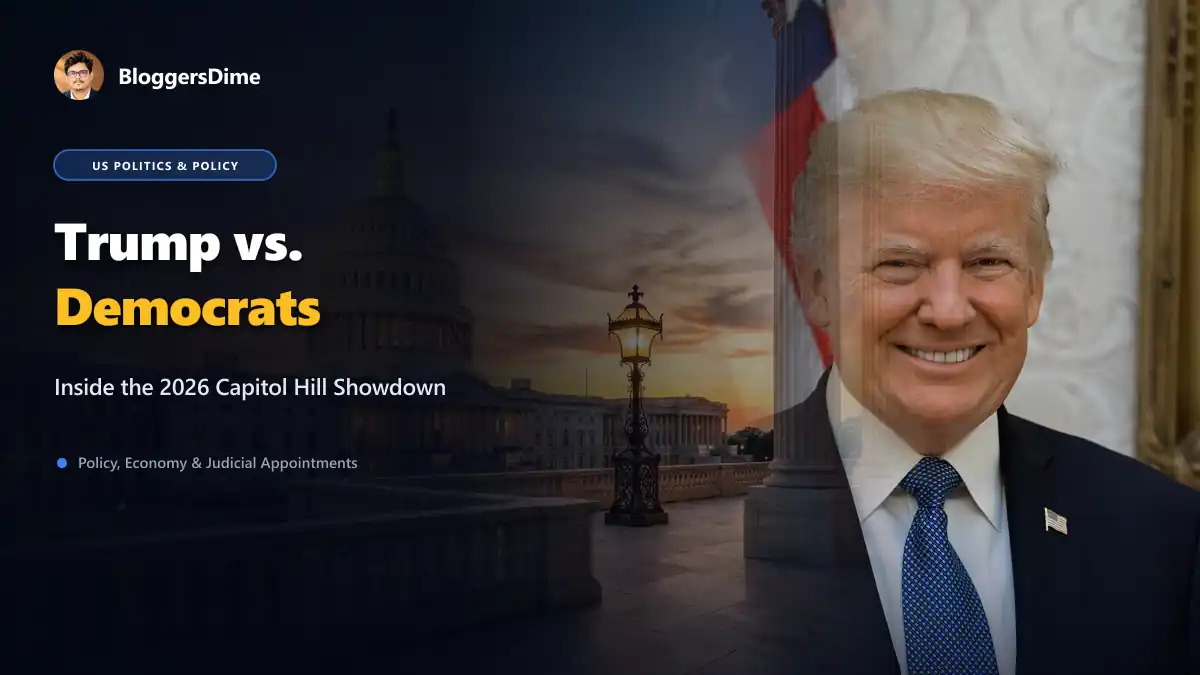
In Washington, D.C., political conflict is the steady rhythm of governing. But in 2026, the temperature inside the marble corridors of Capitol Hill has surged to a boiling point. The friction between the Donald Trump administration and congressional Democrats is no longer confined to campaign soundbites; it has evolved into a full-scale institutional confrontation across committee rooms, federal courthouses, and global economic summits.
Following our recent analyses of how artificial intelligence is reshaping global science and how modern consumer tech is evolving, understanding the geopolitical and legislative forces driving the world’s largest economy is critical for investors, professionals, and global citizens alike. Here is an inside, objective look at the high-stakes showdown shaping American governance in 2026.
The 5 Critical Battlegrounds on Capitol Hill
Rather than a single overarching dispute, the current political deadlock is being fought simultaneously across five distinct policy arenas:
1. Universal Tariffs & Global Trade Architecture
At the epicenter of the White House’s economic agenda is an aggressive re-engineering of global trade. The administration has championed sweeping tariffs designed to shield domestic manufacturing, penalize trade deficits, and compel foreign allies and adversaries to renegotiate bilateral deals.
Congressional Democrats, supported by business coalitions and retail trade groups, argue that broad tariffs function as a regressive national sales tax, driving up inflation on consumer electronics, apparel, and automotive components. The legislative showdown hinges on whether Congress will attempt to reclaim constitutional tariff-setting powers historically delegated to the executive branch.
2. Federal Spending, the Debt Ceiling & Tax Policy
Fiscal policy represents the sharpest ideological dividing line between the two parties. The White House has proposed deep reductions in discretionary federal agency budgets, the consolidation of regulatory departments, and the permanent extension of the 2017 Tax Cuts and Jobs Act.
Democrats have drawn a line in the sand, pledging to protect funding for public education, Medicaid, and environmental programs while advocating for higher corporate tax brackets. With thin legislative majorities in both chambers, annual appropriations bills have turned every budget deadline into a cliffhanger with potential government shutdown implications.
3. Energy Mandates: Fossil Fuels vs. Clean Tech Subsidies
The energy debate has reached peak intensity. The administration has prioritized an “all-of-the-above” energy independence strategy—slashing permitting timelines for natural gas pipelines, leasing public lands for oil exploration, and expediting nuclear power reactors needed to feed energy-hungry AI data centers.
Conversely, Democrats are fighting tooth and nail to defend the clean energy incentives established in previous legislative packages, warning that repealing solar, wind, and electric vehicle battery tax credits threatens billions of dollars in domestic clean-tech manufacturing investments.
4. Judicial Nominations & Federal Agency Oversight
Control of the federal judiciary remains the most enduring prize in American politics. The administration has moved rapidly to confirm constitutional originalist judges across federal appeals courts, while Democrats employ every parliamentary tool—including extended debate and committee boycotts—to scrutinize nominees on executive power limits and civil liberties.
5. Tech Regulation, AI Frontiers & Antitrust
While technology policy occasionally sees unexpected bipartisan cooperation, the approach to artificial intelligence regulation has splintered. The White House supports a streamlined, low-regulation framework that fosters domestic AI leadership and rapid compute expansion to maintain a competitive edge over geopolitical rivals. Democrats continue to push for federal standards addressing algorithmic transparency, workforce displacement, and consumer privacy protections.
Showdown Matrix: Policy Positions & Economic Outcomes
A structured comparison of where both sides stand on key legislative fronts:
| Policy Area | Trump Administration Stance | Democratic Party Stance | Direct Real-World Impact |
|---|---|---|---|
| Trade & Tariffs | Aggressive tariffs to protect domestic jobs & industries | Multilateral alliances; opposition to blanket consumer levies | Supply chain reshoring vs. potential retail price inflation |
| Tax & Fiscal Policy | Extend corporate tax cuts; slash federal agency overhead | Higher corporate taxes; protect healthcare & social safety net | Corporate profit margins, federal debt trajectory, public funding |
| Energy Sector | Deregulate oil, gas, nuclear; accelerate data center power | Protect EV and renewable energy subsidies; emission caps | Energy prices, grid expansion pace, clean tech factory jobs |
| AI & Tech Policy | Deregulatory focus on speed, innovation & national security | Safety standards, labor impact mitigation, antitrust scrutiny | Venture capital deployment, tech stock valuations, data center rules |
| Courts & Governance | Expand executive discretion; confirm originalist judges | Judicial ethics reform; aggressive legal challenges to orders | Long-term legal precedents governing federal regulatory power |
The Democratic Playbook: How the Opposition Is Responding
Facing unified executive authority, congressional Democrats have organized their strategy around three primary pillars:
- The Courthouse Strategy: Partnering with state attorneys general to file emergency injunctions against controversial executive actions, challenging the statutory authority of administrative reorganizations before federal district judges.
- Committee Oversight & Public Hearings: Using congressional committees to conduct high-profile televised inquiries into tariff exemptions, agency funding reallocations, and regulatory appointments to shape public opinion.
- Economic Messaging for 2026 Midterms: Focusing relentlessly on cost-of-living concerns, framing trade duties and corporate subsidies as contributors to daily kitchen-table inflation in suburban swing districts.
What This Means for the Global Economy & Investors
For international financial markets, stability is prized above all else. Protracted standoffs on Capitol Hill create a complex macroeconomic environment:
- Market Bifurcation: Traditional industrial sectors—domestic steel, defense aerospace, and domestic fossil fuels—often rally on protectionist and deregulatory rhetoric, while international logistics, semiconductor exporters, and consumer tech experience volatility.
- The U.S. Dollar & Interest Rates: Conflicting fiscal policies and tariff pressures influence Federal Reserve interest rate projections, directly altering the strength of the greenback against global currencies like the Euro, Yen, and British Pound.
- International Alliances: Trade partners across the European Union, Canada, Mexico, and the Indo-Pacific are hedging against supply disruptions by negotiating regional bilateral agreements independent of Washington.
Frequently Asked Questions (FAQ)
What are the main battlegrounds in the 2026 Trump vs. Democrats showdown?
The primary conflicts center on universal tariff implementations, federal spending cuts, executive agency appointments, clean energy subsidies versus traditional fossil fuels, and judicial appointments.
How do tariff policies impact everyday American consumers?
While proponents argue tariffs protect domestic manufacturing and reshore American industrial jobs, critics and economists warn they can increase consumer prices on imported electronics, automobiles, and retail goods.
What strategy are congressional Democrats using to push back?
Democrats are utilizing federal court injunctions, committee oversight hearings, filibuster maneuvers in the Senate, and targeted messaging in swing congressional districts.
How does the Capitol Hill clash affect Wall Street and the stock market?
Financial markets react with volatility to trade policy announcements, interest rate debates, and corporate tax reform timelines, with sectors like defense and domestic manufacturing seeing rallies while import-dependent retail faces pressure.
What does the political showdown mean for technology and AI regulation?
The administration favors deregulation, open innovation, and energy expansion for AI data centers, whereas Democrats emphasize consumer data privacy, algorithmic bias guardrails, and antitrust scrutiny on Big Tech monopolies.
Final Thoughts: The Resilient Engine of Democracy
While political brinkmanship often appears chaotic, high-stakes debate between the executive branch and congressional opposition is fundamental to the constitutional design of American checks and balances.
As both sides prepare for the upcoming legislative battles and the approaching 2026 midterm elections, the decisions made beneath the Capitol dome will establish the economic, technological, and legal foundations of the nation for the decade ahead.
Leave a Comment
Your email address will not be published. Required fields are marked *