
Elon Musk Net Worth (2026): Inside the Fortune, Tesla & SpaceX Surge, and the Trillionaire Countdown

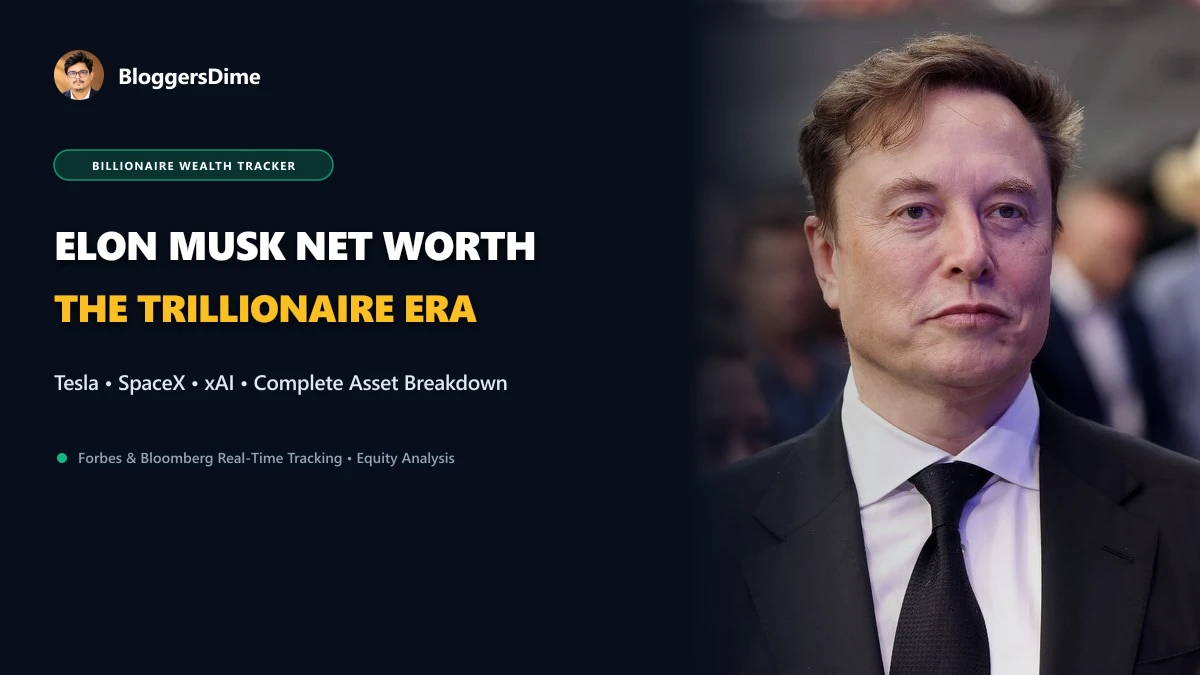
With search queries for "Elon Musk net worth" staging a massive breakout across global financial indexes and search engines, the world's most polarizing industrialist and entrepreneur finds himself at the epicenter of historic wealth creation. Tracked minute-by-minute by the Bloomberg Billionaires Index and Forbes Real-Time Billionaires Tracker, Elon Musk's net worth fluctuates dynamically between $270 billion and upwards of $320+ billion, depending on wild swings in NASDAQ equity prices and private aerospace funding rounds.
Yet beyond the eye-popping headline figures lies an unprecedented industrial empire spanning orbital rocketry, next-generation electric vehicles, humanoid robotics, cutting-edge artificial intelligence, satellite internet constellations, and neural interfaces. As Wall Street analysts, financial institutions, and economic think tanks like Informa Connect Academy debate whether Musk will officially become the world's first verified trillionaire before the decade closes, here is the complete, comprehensive forensic breakdown of where his immense wealth actually resides.
Asset Breakdown: How Elon Musk's Wealth Is Distributed
Unlike traditional billionaires whose fortunes are held in diversified family offices, sovereign bonds, or commercial real estate, Musk’s net worth is concentrated almost entirely in concentrated equity stakes across six frontier technology enterprises:
Key 2026 Portfolio Highlights:
- SpaceX as the Ultimate Growth Engine: With secondary insider tender offers valuing SpaceX at over $210 billion to $250 billion, Musk’s ~42% equity holding represents his single most insulated, fast-compounding asset.
- Tesla (TSLA) Public Equity: Musk owns roughly 12.8% of Tesla’s common stock directly, alongside millions of performance options subject to legal rulings on his landmark executive compensation package.
- xAI & Artificial Intelligence Ecosystem: Following multi-billion dollar funding rounds that propelled xAI’s valuation north of $40 billion to $50 billion, his stake in generative AI rivaling OpenAI and Anthropic has added tens of billions in fresh paper equity.
- Starlink Global Connectivity: Generating billions in high-margin satellite telecommunications revenue, Starlink has transformed SpaceX from a capital-heavy rocket maker into a global recurring-revenue utility.
- Neuralink & The Boring Company: Niche frontier ventures valued between $5 billion and $8 billion each, representing long-term asymmetric upside in medical neurotechnology and urban infrastructure.
Elon Musk Asset & Equity Portfolio Breakdown (2026)
To understand the structural engine behind his net worth, examine this comprehensive breakdown across his active holdings:
| Company / Holding | Ownership Stake | Estimated Asset Value | Key Growth Catalyst | Market Status |
|---|---|---|---|---|
| SpaceX (incl. Starlink) | ~42% | $90B – $110B+ | Starship orbital dominance & Starlink cash flows | Private (Secondary Tenders) |
| Tesla, Inc. (TSLA) | ~12.8% (excl. options) | $85B – $115B | Full Self-Driving (FSD), Cybercab & Optimus humanoid bots | Public (NASDAQ: TSLA) |
| xAI (Grok AI) | ~55% – 60% | $22B – $28B | Memphis Colossus supercluster & enterprise API scale | Private (Venture Backed) |
| X Holdings (formerly Twitter) | ~75% | $9B – $12B | Integration of peer-to-peer payments & AI training data | Private |
| The Boring Company | ~90% | $4B – $5.5B | Las Vegas Loop expansion & municipal tunneling contracts | Private |
| Neuralink Corp. | ~50% – 55% | $3.5B – $4.5B | FDA human clinical trial progression (Telepathy & Blindsight) | Private |
The Trillionaire Countdown: Can Musk Reach $1,000,000,000,000?
In a widely cited global wealth forecast by Informa Connect Academy, analysts noted that Musk’s personal fortune has grown at an astonishing average annual compound rate of over 105%. If that trajectory continues—even with moderate deceleration—Musk is statistically projected to become history’s first trillionaire between 2027 and 2030.
Three colossal catalysts could turn this theoretical milestone into economic reality:
- The Autonomous Robotaxi Fleet & Cybercab: Institutional investment firms such as Ark Invest argue that commercial deployment of unsupervised Full Self-Driving and the dedicated Cybercab platform could unlock an addressable market worth trillions in high-margin mobility services, catapulting Tesla's market capitalization past $3 trillion.
- Commercial Starship & Direct-to-Cell Starlink: With Starship poised to reduce orbital payload delivery costs by two orders of magnitude and Starlink deploying direct-to-cell smartphone connectivity globally with major telecom carriers, SpaceX’s standalone valuation is projected by Morgan Stanley to eclipse $500 billion before the end of the decade.
- Optimus Humanoid Robotics: Musk has publicly stated that Tesla’s Optimus humanoid robot could ultimately dwarf the automotive and energy storage divisions combined. Producing general-purpose industrial robots at a unit cost under $25,000 could transform global manufacturing labor economics.
Tesla Compensation Package & Corporate Governance Dynamics
A crucial factor influencing Musk’s net worth volatility has been the ongoing judicial and boardroom drama surrounding his 2018 CEO Performance Award. Initially approved by shareholders with ambitious valuation and operational tranches (which were subsequently all achieved), the $56 billion stock option package was voided by the Delaware Court of Chancery before being re-ratified by overwhelming shareholder vote at Tesla's annual shareholder meeting.
Because these tranches represent roughly 303 million split-adjusted stock options, how financial trackers account for this pending legal resolution accounts for the multi-billion dollar discrepancies frequently observed between Bloomberg and Forbes real-time daily rankings.
Cash, Debt, and the "Asset-Rich, Cash-Light" Reality
Despite being the richest person on planet Earth, Musk famously holds minimal traditional liquid assets. Rather than taking annual salaries or cash bonuses—he accepts zero salary at Tesla and SpaceX—Musk finances his lifestyle and strategic ventures by pledging equity shares as collateral for low-interest bank margin loans, or by executing structured 10b5-1 stock sales to satisfy hefty tax obligations.
Furthermore, following his pledge to sell off nearly all physical real estate properties, Musk maintains a surprisingly minimalist personal footprint, living primarily in prefabricated modular residences near SpaceX's Starbase production complex in Boca Chica, Texas.
Connected Innovations & Next Frontiers
Musk’s wealth is not merely financial capital—it functions as high-risk developmental capital accelerating real-world technology. Readers exploring his industrial ventures can discover our in-depth reporting on the upcoming Tesla Roadster with SpaceX cold-gas thrusters and how AI models like xAI's Grok are reshaping computational search in our Perplexity AI vs. Google Search breakdown.
Final Assessment: A Modern Industrial Titan
Whether Elon Musk’s wealth settles closer to $300 billion or crosses the legendary $1 trillion mark in the years ahead, his financial trajectory remains without historical equivalent in the modern capitalist era. By tying his fortune directly to humanity’s most audacious technological frontiers—sustainable energy, multi-planetary spaceflight, artificial intelligence, and neurotechnology—Musk’s net worth is more than a metric of personal affluence: it is a real-time barometer of technological transformation across the 21st century.
Leave a Comment
Your email address will not be published. Required fields are marked *