Blue Aadhaar vs White Aadhaar Card: Key Differences, Baal Aadhaar Rules & Mandatory Update Guide

When welcoming a newborn or preparing a toddler for nursery school admissions, many Indian parents are surprised to discover that the Unique Identification Authority of India (UIDAI) issues two distinct identity cards: the standard White Aadhaar Card and the vibrant Blue Aadhaar Card (popularly known as Baal Aadhaar). While both carry a valid 12-digit unique identity number, they operate under fundamentally different rules regarding biometrics, validity periods, and mandatory updates. If you are wondering what sets them apart, whether your child needs one, and how to avoid having it deactivated, here is the complete official guide.
🆔 Quick Summary: Blue Aadhaar vs White Aadhaar
- Target Age: Blue Aadhaar is issued exclusively to children aged 0 to 5 years. White Aadhaar is issued to individuals aged 5 years and above (children & adults).
- Biometrics: Blue Aadhaar requires zero biometrics (no fingerprints, no iris scan). White Aadhaar mandates all 10 fingerprints + 2 iris scans + photograph.
- Validity: Blue Aadhaar is valid only until the child turns 5. White Aadhaar remains valid for a lifetime.
- Mandatory Update: When a child turns 5, parents must complete a Mandatory Biometric Update (MBU) to convert Baal Aadhaar into a standard White Aadhaar.
- Cost: Enrolling for Blue Aadhaar and the age 5/15 Mandatory Biometric Updates are 100% free of cost at all official UIDAI Seva Kendras.
1. What is a Blue Aadhaar Card (Baal Aadhaar)?
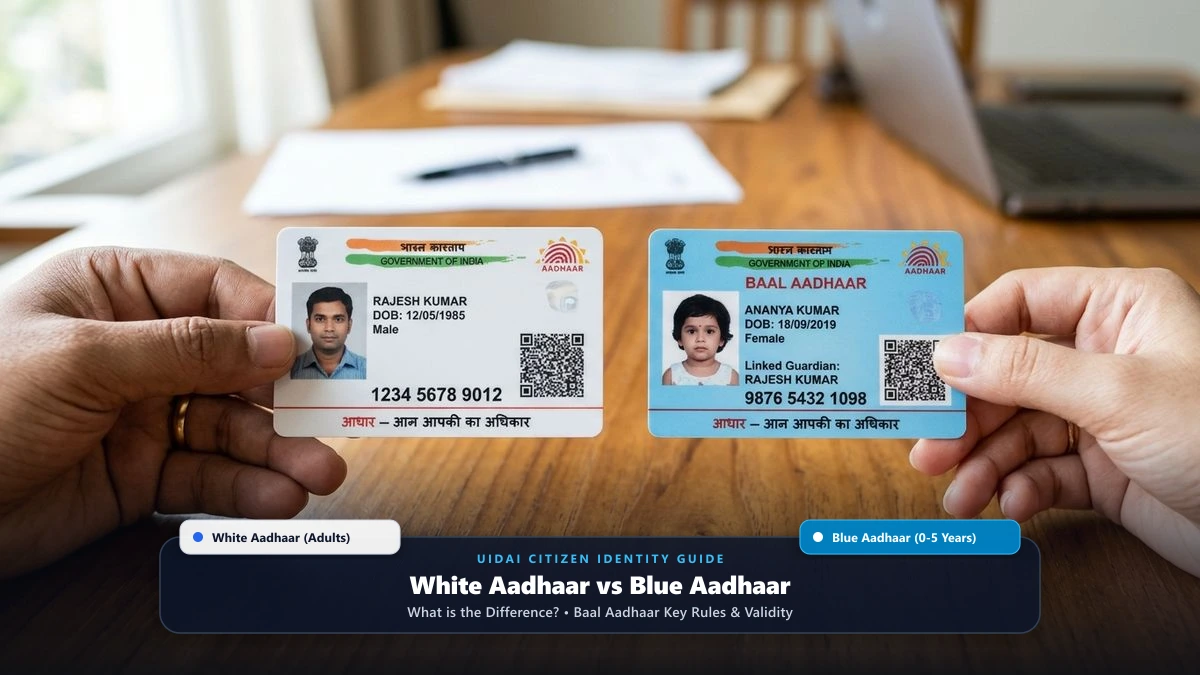
Introduced by UIDAI in 2018, the Blue Aadhaar Card (or Baal Aadhaar) is a specialized identity document designed specifically for newborns, infants, and children under the age of 5. To make it instantly distinguishable from adult identity cards, UIDAI prints the card with a soft sky-blue gradient and prominently marks it as Baal Aadhaar.
Unlike regular identity cards, a child's Blue Aadhaar does not store their own biometric data. Instead, it is cryptographically linked to the biometric credentials and Aadhaar number of either the mother or the father. It serves as an official proof of identity, establishing the child's legal relationship with their parents from day one.
2. What is the Regular White Aadhaar Card?
The White Aadhaar Card is India's standard universal digital identity card, issued to every Indian citizen aged 5 years and older. It features the classic white background, the national emblem, the iconic red fingerprint logo, and a high-density secure QR code.
Every White Aadhaar card contains permanent, individualized biometric data: 10 digital fingerprint impressions, high-resolution iris scans of both eyes, and a facial photograph. Once issued, a White Aadhaar card remains valid indefinitely for life.
3. Master Comparison: Blue Aadhaar vs White Aadhaar
The table below highlights the crucial differences across all official parameters defined by UIDAI:
| Feature | Blue Aadhaar (Baal Aadhaar) | White Aadhaar (Standard) |
|---|---|---|
| Eligible Age Group | 0 to 5 Years (Newborns to Toddlers) | Above 5 Years (Children, Teens & Adults) |
| Card Visual Appearance | Light Sky-Blue Gradient Background | Crisp White Card with National Emblem |
| Biometrics Collected | None (No fingerprint or iris scans captured) | Full Biometrics (10 Fingers + 2 Irises + Photo) |
| Parental Linkage | Mandatorily linked to Mother/Father's Aadhaar | Independent individual identity |
| Validity Period | Temporary: Valid only up to child's 5th birthday | Permanent: Valid for life |
| Primary Purpose | Nursery admissions, child passport, welfare schemes | Universal identity, banking, SIM, exams, jobs, taxation |
| Mandatory Update | Must convert to White Aadhaar at Age 5 & Age 15 | Biometric update at Age 15 (Free of cost) |
| Official Enrollment Fee | ₹0 (100% Free at Aadhaar Seva Kendras) | ₹0 (100% Free at Aadhaar Seva Kendras) |
4. Why Are Biometrics Not Taken for Children Under 5?
Many parents wonder why UIDAI does not scan a baby's fingers or eyes. The reason is rooted in human biology:
- Developing Epidermal Ridges: In infants and children under five, fingerprint ridge structures are extremely delicate and continuously expanding. Optical scanners cannot capture consistent mathematical minutiae points.
- Iris Pigmentation & Stability: A child's eye tissue and iris pigmentation continue maturing throughout early childhood. Iris scans taken before age 5 undergo natural developmental shifts and become unreliable for machine authentication.
By age 5, these physical characteristics achieve sufficient stability to allow lifelong automated biometric recognition.
5. The Mandatory Biometric Update (MBU) Rule: Don't Let It Expire
This is the single most critical rule that thousands of parents miss every year: Blue Aadhaar becomes inoperative (inactive) once the child turns 5 years old unless an MBU is completed.
⚠️ UIDAI's Two Milestone Windows (MBU)
- Milestone 1 (Age 5 to 7): When the child reaches 5 years, parents must take them to an Aadhaar center to record their first set of 10 fingerprints, iris scans, and a fresh photograph. The card is then transitioned to a standard White Aadhaar. UIDAI gives a grace period up to age 7. If missed, the Aadhaar is suspended.
- Milestone 2 (Age 15 to 17): When the teenager turns 15, their adult facial structure and adult fingerprint dimensions finalize. A second MBU must be recorded between ages 15 and 17.
💡 Both Milestone 1 and Milestone 2 updates are completely FREE of cost at all government Aadhaar centers and authorized banks/post offices.
6. Documents Required to Apply for a Blue Aadhaar Card
Applying for a Blue Aadhaar card is quick and requires minimal paperwork:
- Proof of Birth (PoB): The child's official Birth Certificate issued by the Municipal Corporation, Gram Panchayat, or a certified hospital discharge certificate.
- Parent's Identity Proof: The Aadhaar card of either the mother or the father (the parent whose card is linked must be present for biometric authentication).
- Mobile Number: An active mobile number linked with the parent's Aadhaar card to receive verification OTPs.
- Proof of Address: No separate address document is required for the child; the child automatically inherits the parent's residential address.
7. How to Apply for Blue Aadhaar: Step-by-Step
Follow these straightforward steps to obtain a Baal Aadhaar card for your child:
- Book Appointment Online: Visit the official UIDAI portal (myaadhaar.uidai.gov.in) and select "Book an Appointment".
- Enter Details: Fill in the child's full name, date of birth, gender, and the accompanying parent's Aadhaar number.
- Select Nearest Center: Choose your preferred date, time slot, and nearest Aadhaar Seva Kendra, post office, or designated bank branch.
- Visit with Child: On the appointment day, bring the child, their birth certificate, and your original Aadhaar card.
- Photograph & Parent Verification: The enrollment operator takes a photograph of the child. The accompanying parent provides their fingerprint authentication to link the profile.
- Collect Acknowledgment Slip: You will receive an Enrolment Slip with an Enrolment ID (EID). You can track status online, and the physical Blue Aadhaar card will be delivered via Speed Post to your home address within 15–30 days.
Frequently Asked Questions (FAQs)
Is a Blue Aadhaar card mandatory for school admission?
While UIDAI and the Ministry of Education have clarified that no child can be denied school admission solely due to the lack of an Aadhaar card, most private and government schools strongly encourage submitting Baal Aadhaar for streamlined student tracking (APAAR ID) and government scheme disbursements.
Can I download a digital copy of the Blue Aadhaar card?
Yes. Once generated, parents can download the electronic e-Aadhaar of their child via the UIDAI myAadhaar portal or add it directly to their smartphone using the official mAadhaar app under the "Manage Family Profile" section.
What happens if we forget to update biometrics after the child turns 5?
UIDAI provides a grace period up to age 7. If the Mandatory Biometric Update is not completed before age 7, the child's Aadhaar number is placed in a suspended/inactive state. It will not work for passport verifications, bank accounts, or educational benefits until the biometrics are captured.
How much does it cost to update Baal Aadhaar to White Aadhaar?
The conversion from Blue Aadhaar to White Aadhaar via the Mandatory Biometric Update at age 5 (and the second update at age 15) is completely free of cost (₹0). Do not pay any operator fees at authorized centers.
Can a newborn baby get an Aadhaar card?
Yes! There is no minimum age requirement. A newborn infant can be enrolled for a Blue Aadhaar card as soon as their official birth certificate or hospital birth discharge slip is issued.
Leave a Comment
Your email address will not be published. Required fields are marked *
Related Articles