
Dhanteras Gold Investment: Digital Gold vs SGB vs Physical Gold vs Gold ETFs – Complete Comparison Guide

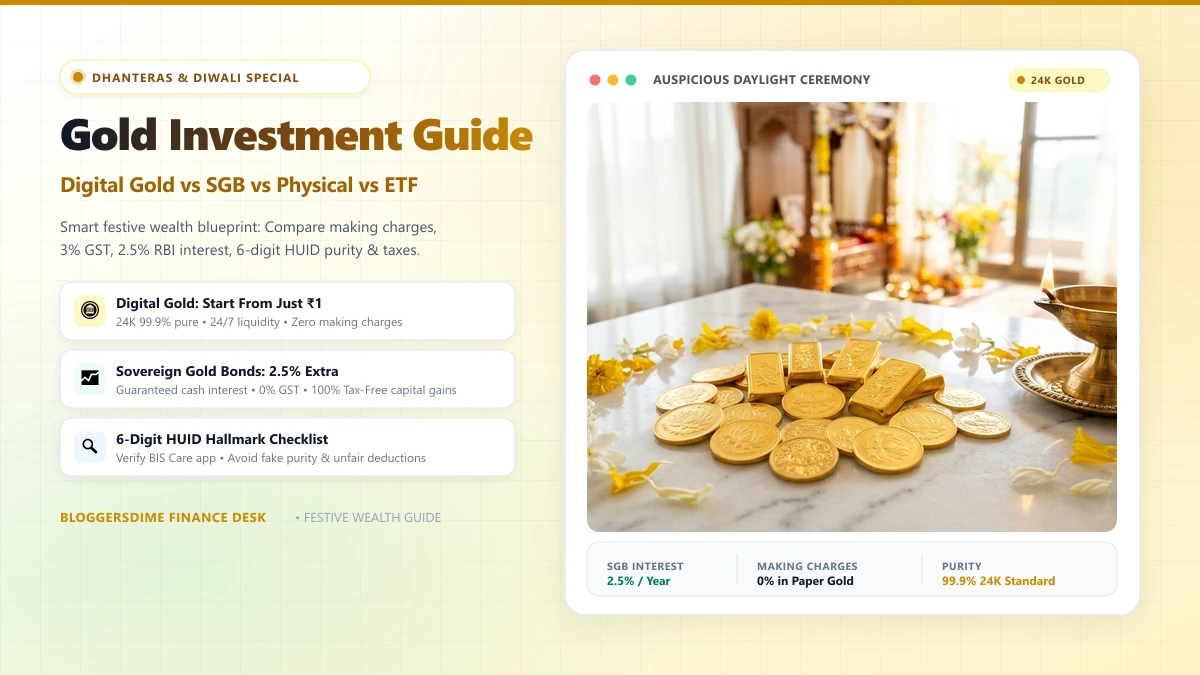
With the festive radiance of Dhanteras and Diwali arriving across Indian households, buying gold remains one of the country's most cherished traditions of welcoming prosperity and Goddess Lakshmi into homes. However, modern investors no longer have to rely exclusively on crowded jewelry stores or heavy making charges. Today, financial technology offers smart, liquid alternatives: Digital Gold, Sovereign Gold Bonds (SGB), and Gold ETFs. If you are planning to invest in gold this festive season, here is the complete, easy-to-understand comparison of returns, taxes, purity, and risks to help you make the smartest choice.
🪔 Quick Verdict: Which Gold Investment Fits Your Festive Goal?
- For Weddings, Family Heirlooms & Festive Rituals: Physical Gold (Always insist on 6-digit HUID Hallmarking).
- For Micro-Savings & Daily/Weekly SIPs (from ₹10): Digital Gold (SafeGold, MMTC-PAMP, Augmont via PhonePe/GPay).
- For Maximum Wealth & 0% Tax (Long-Term 5–8 Years): Sovereign Gold Bonds (SGB) via the RBI secondary market.
- For Stock Traders & Demat Account Holders: Gold ETFs / Gold Mutual Funds (Nippon, HDFC, SBI Gold ETFs).
1. The 4 Ways to Buy Gold in India Explained
A. Physical Gold (Jewelry, Coins & Bullion Bars)
The traditional choice that carries deep emotional and cultural value. You can touch, wear, and store physical gold at home or in bank lockers.
- Pros: Immediate tangible possession, no counterparty digital risk, universally accepted for emergencies and loans.
- Cons: Heavy making charges (8% to 25%) which are not recovered on resale, 3% GST on purchase, theft risk, and ongoing bank locker rental costs.
B. Digital Gold (PhonePe, Google Pay, Paytm, SafeGold)
Digital gold allows anyone with a smartphone to purchase fractional 24K (99.9% pure) gold for as little as ₹1. When you buy digital gold, the custodian (such as MMTC-PAMP or Augmont) stores an equivalent amount of physical bullion in insured vaults under your name.
- Pros: Zero making charges at purchase, instant liquidity (sell 24/7 at real-time market rates), optional physical coin doorstep delivery.
- Cons: Subject to 3% GST on buy price, subtle bid-ask spread (typically 2–3% gap between buying and selling price), and maximum holding limits (usually 5–7 years before mandatory delivery or sale).
C. Sovereign Gold Bonds (SGB)
Issued by the Reserve Bank of India (RBI) on behalf of the Government of India, SGBs are government securities denominated in grams of gold. While new primary tranches have been curtailed, existing tranches can be actively traded and bought on NSE/BSE secondary markets via your Demat account.
- Pros: 2.50% annual guaranteed interest paid semi-annually into your bank account, zero storage costs, 100% Tax-Free capital gains if held until the 8-year maturity.
- Cons: Long lock-in period (8 years, with premature exit windows after year 5), and trading volume on the secondary market can occasionally trade at a slight discount/premium.
D. Gold ETFs (Exchange Traded Funds)
Gold ETFs are open-ended mutual fund units that track the domestic physical gold price. One ETF unit typically represents 0.01 gram or 1 gram of 99.5% pure gold and trades seamlessly on stock exchanges during market hours.
- Pros: Highest liquidity, extremely transparent pricing with zero making charges, minimal expense ratios (0.3% to 0.8% annually), safe Demat holding.
- Cons: Requires a brokerage and Demat account, no physical gold delivery for retail investors.
2. Master Comparison Table: Physical vs Digital vs SGB vs ETF
| Feature | Physical Gold | Digital Gold | Sovereign Gold Bond (SGB) | Gold ETFs |
|---|---|---|---|---|
| Minimum Investment | ~₹7,500 (1 gram) | ₹1 to ₹10 | 1 gram | ~₹75 (0.01g unit) |
| Gold Purity | 22K / 18K (Jewelry) or 24K | 24K (99.9% pure) | 999 Pure Grade (Sovereign) | 99.5% Standard |
| Making / Entry Charges | 8% to 25% | Nil (at purchase) | Nil | Nil |
| GST on Purchase | 3% GST | 3% GST | 0% (Exempt) | 0% (Exempt) |
| Extra Returns | None | None | +2.50% / year cash interest | None |
| Capital Gains Tax | 12.5% LTCG (after 24 mos) | Taxed at investor slab | 100% Tax-Free (at maturity) | 12.5% LTCG (after 12 mos) |
| Storage & Theft Risk | High (Home/Locker) | Zero (Insured Vault) | Zero (Demat/RBI ledger) | Zero (Demat safe) |
3. Crucial Purity Checklist: The 6-Digit HUID Rule
If you do choose to purchase physical jewelry or coins this Dhanteras, ensure you verify the mandatory HUID (Hallmark Unique Identification) mark. The Bureau of Indian Standards (BIS) has made it illegal for jewellers to sell non-HUID hallmarked gold in India.
Check These 3 Marks on Hallmarked Gold:
- BIS Triangle Logo: Signifies authorized certification by the national standards bureau.
- Purity & Fineness Mark:
22K916for 22 karat (91.6% purity),18K750for 18 karat (75% purity), or24K999for investment coins. - 6-Digit Alphanumeric Code: A unique laser-engraved code (e.g.,
AB1234) that you can verify instantly on the free BIS CARE App to verify the jeweller’s license and authenticity.
Frequently Asked Questions (FAQs)
Can I convert my Digital Gold into physical gold coins?
Yes. Platforms like SafeGold, MMTC-PAMP, and Augmont allow you to request physical doorstep delivery in tamper-proof certified packaging starting from 0.5 grams or 1 gram, subject to nominal minting and delivery charges.
Why is Sovereign Gold Bond (SGB) considered the best investment?
SGBs offer a guaranteed 2.5% annual interest credit to your bank account, zero storage costs, and complete capital gains tax exemption if held until redemption at 8 years.
Do I need a Demat account to buy Gold ETFs?
Yes, Gold ETFs are traded on stock exchanges (NSE/BSE) and require an active Demat and trading account (like Zerodha, Groww, Upstox, or Angel One). Alternatively, you can invest in Gold Mutual Funds without a Demat account.
How much GST is applicable on buying gold during Dhanteras?
Physical gold jewelry and digital gold both attract a flat 3% Goods and Services Tax (GST) on the purchase value. Sovereign Gold Bonds and Gold ETFs are exempt from GST.
Leave a Comment
Your email address will not be published. Required fields are marked *
Related Articles