Tesla Roadster "Flying Car" Unveiled: 0-60 in 0.81s, SpaceX Thrusters, and What Elon Musk Just Proved

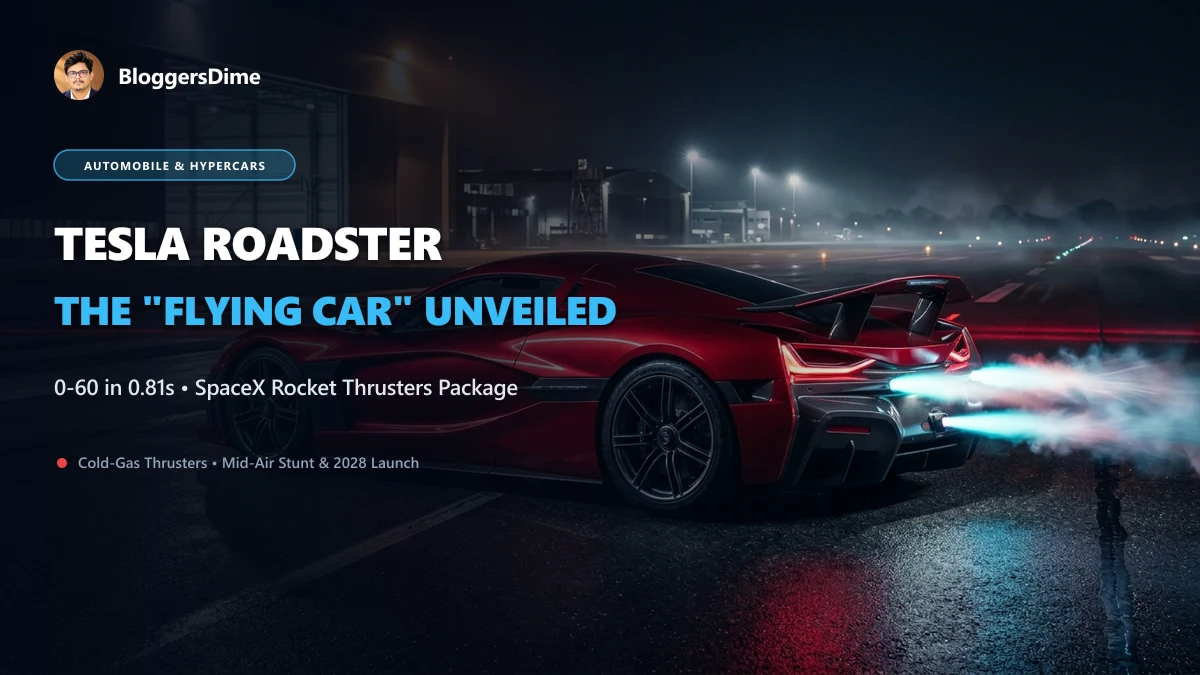
For nearly a decade, the next-generation Tesla Roadster was treated as Silicon Valley’s ultimate piece of vaporware—announced back in 2017 and repeatedly deferred as Tesla prioritized mass-market models like the Model Y and Cybertruck. But over the last 24 hours, over 100,000 searches for "Tesla flying car" and "Tesla roadster SpaceX thrusters" exploded across global search engines after Elon Musk executed a live engineering demonstration that seemed straight out of a science-fiction epic.
Gathered at SpaceX’s testing proving grounds in McGregor, Texas, automotive journalists, aerospace engineers, and industry analysts watched in disbelief as a deep crimson Roadster prototype accelerated up a curved launch ramp, performed an airborne mid-pitch rotation assisted by high-pressure cold-gas reaction thrusters, and touched down cleanly on all four wheels. Following our earlier breakdowns of cutting-edge superbike engineering, we dive into the radical technology behind Tesla’s airborne hypercar.
The McGregor Stunt: What Actually Happened?
Unlike conventional eVTOL (electric vertical takeoff and landing) aircraft designed to commute thousands of feet above gridlocked highways, Musk clarified that the Roadster is not meant to replace private planes. Instead, it leverages aerospace attitude-control systems to shatter the physical boundaries of automotive acceleration and cornering dynamics.
The demonstration vehicle featured an intelligent underbody suction fan system coupled with ten miniaturized cold-gas rocket thrusters arranged around the perimeter of the chassis. During the high-speed run:
Breakdown of the Airborne Demonstration:
- Ramp Launch & Attitude Control: As the vehicle cleared the apex of the test ramp, pulse-firing thrusters counteracted rotational inertia to maintain level pitch.
- Reaction Mass Cold-Gas Bursts: Firing ultra-purified compressed air at over 10,000 PSI, the thrusters exerted several hundred pounds of instantaneous counter-thrust.
- Zero Rocket Fuel Flame: Because the thrusters rely entirely on compressed ambient gas rather than volatile rocket propellants, there are no flames, hazardous combustion exhaust, or thermal runway risks.
- Four-Wheel Controlled Touchdown: High-speed active air suspension absorbed the kinetic shock of landing seamlessly, allowing the car to immediately resume ground acceleration.
The Physics of 0-60 in 0.81 Seconds: Breaking the Friction Limit
In conventional automotive engineering, a vehicle's maximum acceleration is fundamentally bottlenecked by the coefficient of friction (μ) between rubber tires and asphalt. Even on a prepped drag strip with warm racing slicks, the theoretical limit for road-legal tires hovers around 1.4 to 1.6 seconds for a 0–60 mph sprint.
Tesla bypasses this classical physics barrier through external reaction propulsion. By replacing the small rear passenger seats with a massive carbon-overwrapped pressure vessel (COPV)—the identical high-pressure tank used on SpaceX Falcon 9 rocket second stages—the Roadster discharges horizontal reaction mass behind the rear license plate cradle.
Simultaneously, downward-facing nozzles blast high-pressure air upward, generating artificial aerodynamic downforce even when standing completely motionless. This pins the tires to the pavement with thousands of pounds of simulated vehicle mass, eliminating wheel slip and delivering an astonishing 0 to 60 mph launch in approximately 0.81 seconds.
Hypercar Benchmark: Roadster vs. The World’s Elite
To understand the unprecedented scale of performance claimed for the production Roadster, observe how its engineering targets stack up against the pinnacle of internal combustion and electric hypercars:
| Vehicle Model | Powertrain | 0–60 mph | Top Speed | Starting Price |
|---|---|---|---|---|
| Tesla Roadster (SpaceX Package) | Tri-Motor Plaid + 10 Cold-Gas Thrusters | ~0.81 Seconds | 250+ mph (402+ km/h) | $250,000 (Est.) |
| Rimac Nevera R | Quad-Motor EV (2,107 HP) | 1.74 Seconds | 256 mph (412 km/h) | $2,530,000 |
| Bugatti Tourbillon | 8.3L V16 Hybrid (1,775 HP) | 2.0 Seconds | 276 mph (445 km/h) | $4,100,000 |
| Ferrari SF90 XX Stradale | 4.0L Twin-Turbo V8 PHEV (1,016 HP) | 2.3 Seconds | 199 mph (320 km/h) | $890,000 |
| Porsche Taycan Turbo GT | Dual-Motor EV (1,019 HP) | 2.1 Seconds | 190 mph (305 km/h) | $230,000 |
Is It Street-Legal? Navigating the Regulatory Minefield
While the engineering feasibility of cold-gas thrusters is verified by aerospace science, road-going homologation presents unprecedented regulatory hurdles with agencies such as the National Highway Traffic Safety Administration (NHTSA) in the US and UNECE in Europe:
- Pedestrian Acoustic Hazards: Discharging air at 10,000 PSI generates acoustic sound pressure levels exceeding 120 decibels. Tesla has reportedly designed specialized sonic silencer baffles to suppress discharge noise to permissible municipal decibel tiers.
- Foreign Object Debris (FOD): Downward-directed thrusters risk kicking up gravel, asphalt fragments, and road dust at lethal velocities. Engineers indicate the downward-facing nozzles may only unlock via GPS on approved race tracks and closed drag strips.
- Pressure Vessel Inspections: Department of Transportation (DOT) certification for 10,000 PSI composite tanks requires periodic ultrasonic testing similar to commercial hydrogen and aerospace fuel cells.
Trim Levels, Pricing, and the 2028 Production Roadmap
Tesla has officially announced a targeted commercial production timeline beginning in 2028, manufactured in limited volumes at a dedicated skunkworks facility near Gigafactory Texas. Three distinct configurations have been confirmed:
- Base Roadster ($200,000): Pure electric tri-motor all-wheel-drive powertrain, delivering 0–60 mph in 1.9 seconds, a top speed of 250 mph, and a 200 kWh structural battery pack yielding an estimated 620-mile real-world highway range.
- Roadster Thrust Package ($250,000): Adds active underbody suction fans, ceramic-matrix composite brakes, and track-only high-downforce aero winglets.
- SpaceX Rocket Package (Invite Only / Founder Tier): Complete cold-gas thruster integration, Falcon 9 composite pressure vessels, high-rate air compressors, and sub-second 0–60 launch capability.
Final Verdict: The Convergence of Automotive & Space Flight
Whether or not everyday drivers ever witness a Tesla Roadster execute a mid-air hop on public roadways, the McGregor demonstration has already achieved its primary strategic objective: completely rewriting the ceiling of hypercar performance. In an era where legacy combustion supercars costing millions are reaching their mechanical limits, Tesla and SpaceX have demonstrated that the future of automotive speed will not just roll on rubber—it will harness the power of flight.
Leave a Comment
Your email address will not be published. Required fields are marked *