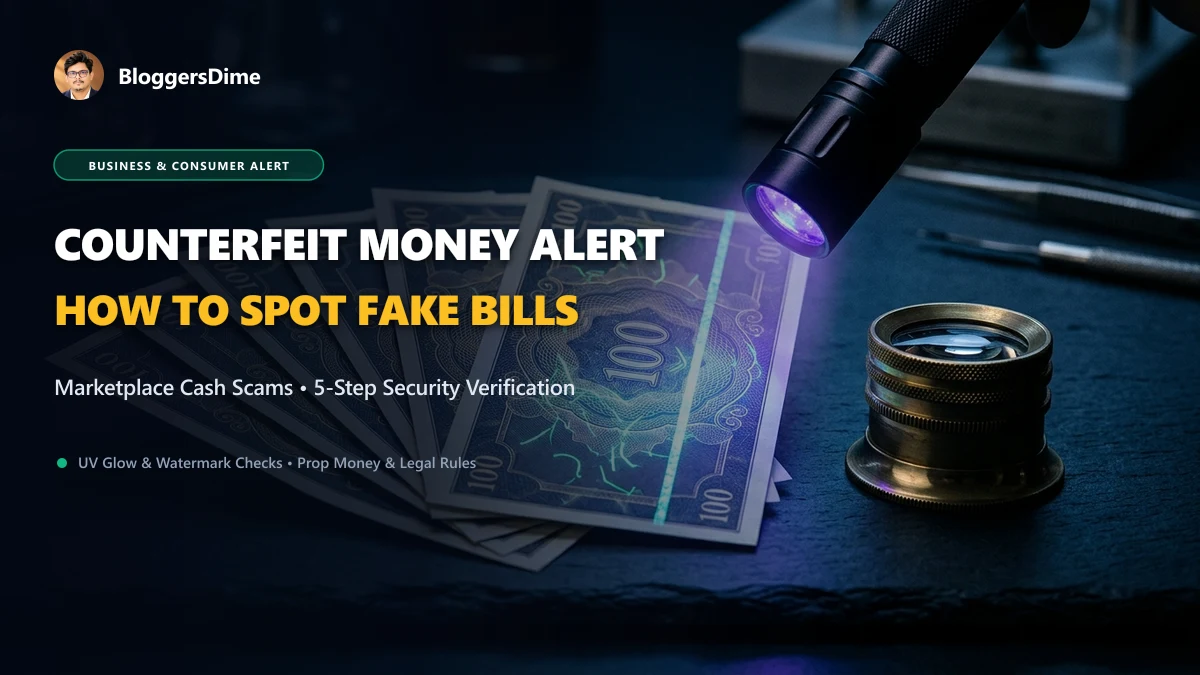
Counterfeit Money Alert (2026): How to Spot Realistic Fake Bills, New Marketplace Cash Scams, and Official Legal Rules

A sudden nationwide spike of over 20,000 real-time searches for "counterfeit money" has highlighted a concerning trend facing consumers and small business owners: a sophisticated resurgence of fake banknotes circulating through peer-to-peer (P2P) online marketplaces and retail checkouts. Driven by high-profile police busts and urgent law enforcement advisories, millions of everyday sellers are discovering that parting with an iPhone, laptop, or designer handbag for cash carries unexpected risks.
Recent police reports from suburban departments and municipal task forces reveal a recurring modus operandi: buyers offer to purchase high-value tech devices on platforms like Facebook Marketplace, OfferUp, and Craigslist, insist on paying entirely in cash, and hand over a bundle of crisp $100 or $50 bills under dim evening lighting—bills that bank tellers later identify as counterfeit or altered theatrical prop money.
The Evolution of Modern Counterfeiting: Why Fakes Look So Real
Gone are the days when counterfeit currency was easily identified by blurry ink or cartoonish portraits. Today's illicit operations employ sophisticated techniques that challenge casual inspection:
Primary Modern Counterfeit Methods:
- Chemical Note Bleaching: Criminals use chemical solvents to strip ink from genuine lower-denomination notes (such as $1 or $5 bills) and reprint $100 designs onto the authentic cotton-linen paper, allowing fakes to pass standard iodine counterfeit detector pens.
- High-Resolution Digital Offset Printing: High-end industrial digital presses capable of mimicking microprinting and fine-line intaglio portrait textures.
- Faux Holographic Foils: Metallic plastic strips applied to mimic the 3D security ribbon found on modern high-denomination banknotes.
- Exploitation of "Motion Picture" Prop Bills: Chinese and international imports of prop currency designed for film sets—often stamped with small disclaimers like "For Motion Picture Purposes"—passed off to distracted private sellers.
The 5-Step Forensic Verification Guide: How to Verify Cash Instantly
Federal central banks and the U.S. Secret Service emphasize that genuine banknotes incorporate multi-layered sensory security features that cannot be duplicated simultaneously on commercial equipment:
| Security Feature | Authentic Banknote Indicator | Counterfeit Tell | Test Method |
|---|---|---|---|
| Paper Texture (Touch) | 75% cotton / 25% linen blend; distinctly crisp, rough, slightly raised ridges | Smooth, slick, flimsy printer paper or excessively stiff cardstock | Fingertip scratch test across president's lapel |
| Color-Shifting Ink | Numeral in bottom right corner dramatically shifts from copper to vibrant green | Flat glitter or static metallic paint with zero color variation | Tilt the bill back and forth under normal light |
| Embedded Watermark | Faint duplicate portrait embedded inside the paper, visible from both sides | Dark stamped portrait visible on surface without holding up to light | Hold bill up directly to ambient backlight |
| 3D Security Ribbon | Woven into paper (not printed); bells shift to 100s when tilted | Glued-on silver foil sticker that can be peeled at corners | Tilt vertically and horizontally to observe motion |
| UV Fluorescence (Ultraviolet) | Vertical security thread glows distinct color (e.g. pink for $100, yellow for $50) | Entire paper glows bright blue/white like copy paper, or zero thread glow | Inspect under blacklight / UV LED torch |
The Dangerous "Prop Money" Trap on Social Marketplaces
One of the fastest-growing financial fraud schemes does not involve traditional counterfeiting syndicates at all. Scammers purchase bundles of theatrical prop cash online for less than $15 per hundred bills. These bills are engineered to look identical to real money on video cameras.
To avoid federal counterfeiting charges, manufacturers print subtle disclaimers such as "THIS NOTE IS NOT LEGAL TENDER - FOR MOTION PICTURE USE ONLY" or replace "United States of America" with "In Props We Trust."
When conducting in-person transactions in parking lots at dusk, fraudsters fold the bills so the disclaimer is hidden under the paper fold, place a genuine $100 bill on the top of the stack, and hand the wad to an unsuspecting seller who rushes through the count. By the time the seller examines the bills under daylight, the buyer has vanished.
What Should You Do If You Receive a Counterfeit Note?
Discovering that you are holding counterfeit currency is frustrating, but knowing your legal responsibilities is critical to avoiding criminal liability:
- Do NOT Attempt to Spend or Pass the Bill: Passing counterfeit currency with knowledge of its falsity is a federal felony punishable by heavy fines and up to 20 years in prison. Even if you were innocently defrauded, attempting to "pass the loss" to another merchant makes you criminally liable.
- Minimize Physical Handling: Handle the bill as little as possible. Carefully place it inside a clean paper envelope or plastic sleeve to preserve fingerprint and DNA evidence.
- Document the Transaction: Note down every detail regarding the person who gave you the note: physical description, vehicle make and license plate, social media profile, and exact timestamp.
- Contact Local Law Enforcement or the Secret Service: Deliver the bill to your local police department or nearest U.S. Secret Service field office. You will be asked to complete a Counterfeit Note Report (Form SSF 1604).
- Check with Financial Institutions: If you receive cash from an ATM that turns out to be suspect, immediately report it to the branch manager with your transaction receipt. Banks operate specialized reconciliation logs to trace ATM cash dispensing cassettes.
Best Practices for Marketplace Sellers & Small Businesses
To safeguard your hard-earned merchandise against counterfeit fraud, implement these simple, fail-safe rules:
- Transact at Safe Exchange Zones: Conduct high-value cash transactions inside bank lobbies or designated police station safe exchange zones equipped with 24/7 high-definition surveillance.
- Deposit Directly with the Buyer Present: Meet your buyer directly inside your bank and have the teller run the cash through their commercial sorter before handing over the goods.
- Carry a Compact UV / Magnetic Detector: Portable dual-sensor verification devices cost under $20 and verify magnetic ink and UV security threads in less than two seconds.
- Prefer Instant Verified Digital Transfers: For transactions exceeding $500, utilize irreversible bank-backed digital transfers (such as Zelle, wire transfers, or direct in-branch cashier’s checks) rather than handling thick stacks of cash.
Final Verdict: Vigilance in the Cash Economy
While digital payments continue to dominate modern commerce, cash remains the undisputed king of fast, anonymous peer-to-peer transactions. As counterfeiters adopt increasingly deceptive printing techniques and prop-money scams proliferate, basic currency literacy is your strongest shield. By understanding the feel, tilt, and light tests of genuine banknotes, you can protect your wallet and ensure you never become an unwitting victim of fake currency.
Leave a Comment
Your email address will not be published. Required fields are marked *