Stop Wasting Your Teenage Years: The Neurobiology of Youth, Compounding Habits & Mistakes You Will Regret in Your 20s

Ask anyone in their late twenties or early thirties what they would trade to relive their teenage years, and the answer is almost universal: they wouldn't trade it to attend more parties or buy flashier clothes—they would trade it for the priceless luxury of unencumbered time and peak neuroplasticity.
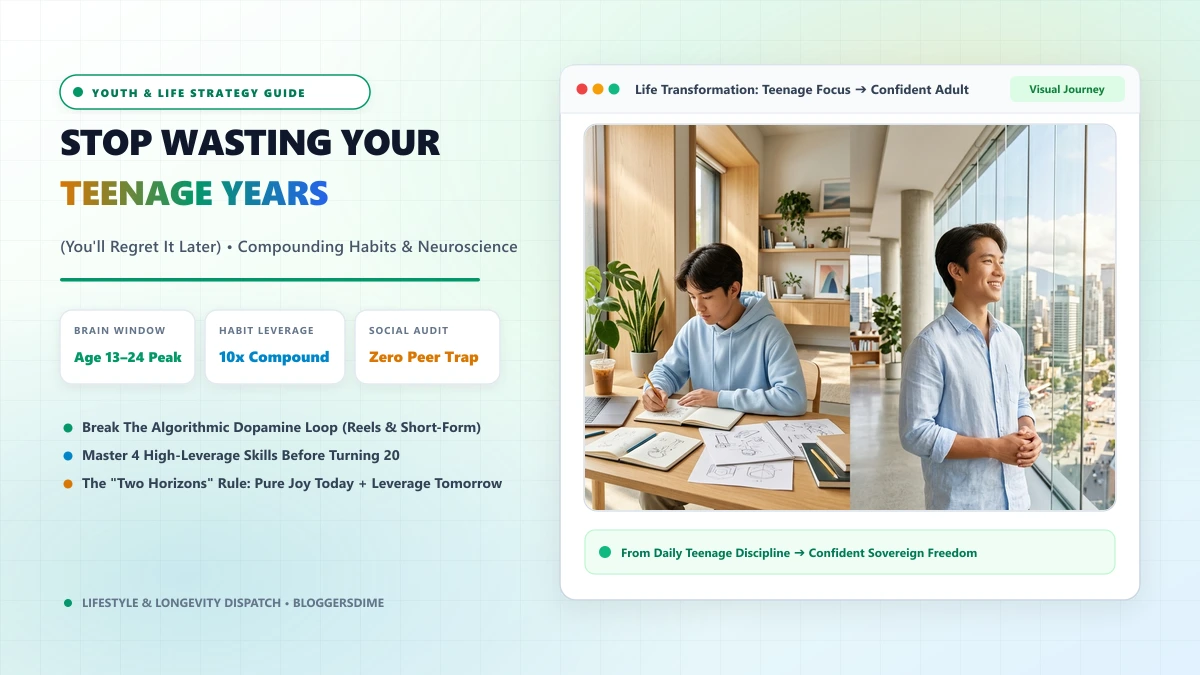
When you are 16, time feels infinite. Days stretch endlessly, adult responsibilities seem decades away, and the temptation to surrender five hours an afternoon to an algorithmic feed of TikToks, Reels, and Discord banter feels completely harmless. But beneath the surface of everyday teenage life, an irreversible biological and mathematical countdown is ticking. The habits, physical foundations, and cognitive wiring you forge between the ages of 13 and 22 do not merely shape your adolescence—they compound exponentially to determine your financial sovereignty, mental resilience, and career velocity for the next four decades.
Youth Trajectory Audit: Low-Yield Traps vs. High-Leverage Strategic Swaps
How micro-decisions made during your teenage years compound into massive divergence by age 25.
| Teenage Domain | The Default Trap (Regret Generator) | The High-Leverage Strategic Swap |
|---|---|---|
| Attention & Media | 4+ hours of passive algorithmic scrolling (destroying dopamine receptors and focus). | 1 hour of active creation (coding, digital writing, technical video editing, or building tools). |
| Social Circle | Chasing peer validation from classmates who will drift away 12 months after graduation. | Cultivating 2–3 authentic, high-agency friendships and building comfort with constructive solitude. |
| Physical Health | Erratic sleep schedule (3 AM screens), ultra-processed diet, and sedentary video gaming. | Consistent circadian rhythm (8 hours sleep) paired with compound strength training and clean nutrition. |
| Financial Mindset | Blowing 100% of allowances/part-time income on trendy fast fashion and consumer dopamine. | Learning compounding interest, index investing basics, and avoiding the consumer debt trap early. |
The Neurobiology of Youth: Why Your Brain Between 13 and 24 Is a Supercomputer
Most adolescents view self-improvement as a chore invented by nagging parents and teachers. In reality, modern cognitive neuroscience reveals that your teenage brain is experiencing a biological miracle that will never happen again: peak neuroplasticity and synaptic pruning.
During childhood, the brain produces billions of synaptic connections. When puberty hits, the brain begins a ruthless structural optimization process governed by the prefrontal cortex—a phenomenon known in neuroscience as synaptic pruning. The biological rule is simple: use it or lose it.
- The Synapses You Exercise: If you spend an hour every day between ages 14 and 19 practicing deep problem-solving, writing code, learning an instrument, or mastering athletic mechanics, your brain insulates those neural pathways with dense layers of myelin. This transforms those cognitive actions into permanent, high-bandwidth highways that operate with effortless speed for the rest of your life.
- The Synapses You Neglect: Neural circuits that remain unexercised are trimmed away by microglia cells. If your primary cognitive activity is reacting to 15-second micro-videos, your brain prunes away the neural hardware required for sustained focus, patience, and delayed gratification.
The Algorithmic Dopamine Hijack: How Modern Apps Steal Your Agency
Never in human history has a generation of young minds faced multi-billion-dollar supercomputers engineered specifically to hijack their neurochemistry. Social media algorithms are not neutral entertainment feeds—they are variable-reward Skinner boxes calibrated by behavioral psychologists to extract your attention and convert it into advertising impressions.
Every time you swipe to a new short-form clip, your brain releases a microscopic spike of dopamine in anticipation of novel stimuli. Over weeks and months, your baseline dopamine threshold elevates. Everyday reality—reading a 300-page book, debugging complex code, practicing a sport, or having an uninterrupted conversation—begins to feel unbearably boring.
The Cost of the Hijack: When you surrender four hours a day to passive scrolling between ages 14 and 20, you aren't just losing 8,760 hours of life. You are actively training your prefrontal cortex to develop an attention span measured in seconds, leaving you crippled when entering university lecture halls or competitive professional environments that demand hours of deep focus.
The Asymmetric Compounding Curve: The 10-Year Arbitrage
Mathematical compounding is typically taught through financial balances, but its most devastating impact occurs in human skills and reputation. Consider two sixteen-year-olds:
- Person A (The Default Consumer): Spends four hours each evening after school gaming and scrolling. By age 22, they graduate with an average degree, zero specialized portfolio projects, a fragile attention span, and zero financial savings. At 23, they start from square one in an unforgiving, hyper-competitive job market.
- Person B (The Compounding Builder): Still hangs out with friends and plays sports, but ruthlessly guards 60 to 90 minutes of daily deliberate focus. From age 15 to 22, that single daily hour accumulates to over 2,500 hours of specialized practice. They master programming, technical writing, video editing, or foreign languages. By age 22, they don't apply for jobs—they are headhunted because they have a seven-year body of work that 99% of university graduates cannot match.
This is the 10-Year Arbitrage. Starting at 16 gives you an unfair, asymmetric advantage because you have zero mortgage, zero dependents, and negligible living expenses. The risks you take at 17 carry virtually zero downside and infinite upside.
The "Peer Approval Trap": The Social Validation Audit
Perhaps the most tragic mistake teenagers make is sacrificing their sovereign individuality to gain the approval of a fleeting social hierarchy. In high school and early college, social anxiety convinces you that what your peers think of your clothes, your music, or your awkwardness is life-or-death.
Here is the hard truth that every 28-year-old realizes too late: Within two years of finishing high school or university, 95% of your social circle will completely scatter. They will move cities, change careers, start families, and be consumed by their own struggles. The "cool kids" whose judgment dictated your decisions at 16 will become distant names on a LinkedIn or Instagram feed.
Sacrificing your health, financial foundation, or academic and technical mastery to avoid being called a "nerd" or "try-hard" by people you will never speak to again is the worst trade-off in human psychology. Embrace the power of constructive solitude. The world does not reward people who blend in; it rewards the rare individuals who spent their youth building rare, valuable skills in quiet isolation.
The 4 High-Leverage Pillars to Master Before Turning 20
You do not need to overhaul your entire life overnight. Focusing on these four foundational pillars will position you in the top 1% of your age bracket:
1. Deep Work & Cognitive Endurance
In an economy overrun with distraction, the ability to sit in a quiet room and focus deeply on a single hard problem for 90 minutes without checking your phone is a superpower. Train your brain like an athletic muscle: start with 25 minutes of single-tasking (the Pomodoro technique), eliminate phone notifications, and gradually build up to 90-minute blocks of unbroken creative or analytical work.
2. High-Leverage Communication & Articulation
Brilliance without articulation is worthless. If you have great ideas but cannot write clear sentences or speak with confidence, you will be constantly overlooked. Write essays online, participate in debates, learn how to tell compelling stories, and master the art of listening. Those who write clearly think clearly.
3. Physical & Metabolic Foundations
The metabolic habits and posture you establish in your teens follow you for life. Build a disciplined physical routine around three pillars: compound resistance training (building bone density and lean muscle mass), clean unprocessed nutrition (adequate protein and hydration), and strict circadian hygiene (going to bed and waking up at consistent hours to optimize growth hormone release).
4. Financial Literacy & Compounding Basics
You don't need a Wall Street salary to understand the laws of capital. Understand the difference between assets (things that put money in your pocket) and liabilities (things that take money out). Learn how inflation erodes purchasing power, how low-cost broad-market index funds work, and never, under any circumstances, take on high-interest consumer debt or credit card balances to purchase depreciating luxury goods.
The "Two Horizons" Rule: Enjoying Your Youth Without Sacrificing Your Future
A common critique of self-improvement advice is that it turns teenagers into soulless productivity robots who miss out on the romance and spontaneous magic of being young. That is not the philosophy of BloggersDime.
We advocate the Rule of Two Horizons:
The 80/20 Youth Protocol:
Dedicate 20% of your daily waking hours (approximately 90 minutes) to rigorous, non-negotiable self-mastery: reading, deep skill acquisition, and physical fitness. The remaining 80% of your day is yours to enjoy completely guilt-free—laugh with friends, ride bikes, play music, go on road trips, and make unforgettable memories. By taking care of the 20% first, you eliminate the constant background anxiety of wasted potential.
The 30-Day Youth Reset Protocol
If you feel overwhelmed and unsure of where to start, commit to this simple 30-day challenge:
- Digital Sunset: Place your smartphone in another room at 10:00 PM every night. No screens in bed. Read physical books until you fall asleep.
- Morning 60: Spend the first 60 minutes after waking up without opening any social media app. Drink water, get natural sunlight into your eyes, and exercise.
- One Creation Block: Dedicate 45 minutes daily to building a tangible project—a blog post, a coding project, an art piece, or learning a marketable skill.
- Social Audit: Unfollow or mute accounts that induce envy, materialism, or mindless doomscrolling. Curate your digital environment to inspire action rather than passivity.
Frequently Asked Questions (FAQ)
Why is the teenage brain uniquely suited for skill acquisition?
Between ages 13 and 24, the human brain undergoes peak neuroplasticity and synaptic pruning. Neural connections that are frequently exercised become heavily myelinated and permanent, while unused circuits are discarded. Skills practiced during this decade become lifelong second-nature instincts.
Does self-improvement mean sacrificing high school friendships or fun?
No. The goal is the "Two Horizons" model: dedicating just 60 to 90 minutes of daily deliberate focus to high-value skill mastery while using the remaining 90% of your free waking hours to cultivate authentic friendships, play sports, and create genuine memories.
What is the biggest regret people express about their teenage years in their late 20s?
The most common regret is passive time dissipation—spending 4 to 6 hours every day on low-effort entertainment (endless social scrolling and gaming marathons) to appease boredom or peer approval, only to reach age 25 with zero leverage, zero savings, and uncalibrated focus.
What are the four most valuable skills to learn before turning 20?
1) Deep Focus (distraction-free 90-minute blocks), 2) High-leverage communication (concise writing and public speaking), 3) Physical health foundations (compound strength and circadian sleep hygiene), and 4) Basic financial literacy (the power of compounding and avoiding consumer debt).
Leave a Comment
Your email address will not be published. Required fields are marked *